

Systems & Scale
Designing for scale

I design systems that remove friction, protect brand integrity, and enable teams to operate independently, allowing creative work to scale without breaking.
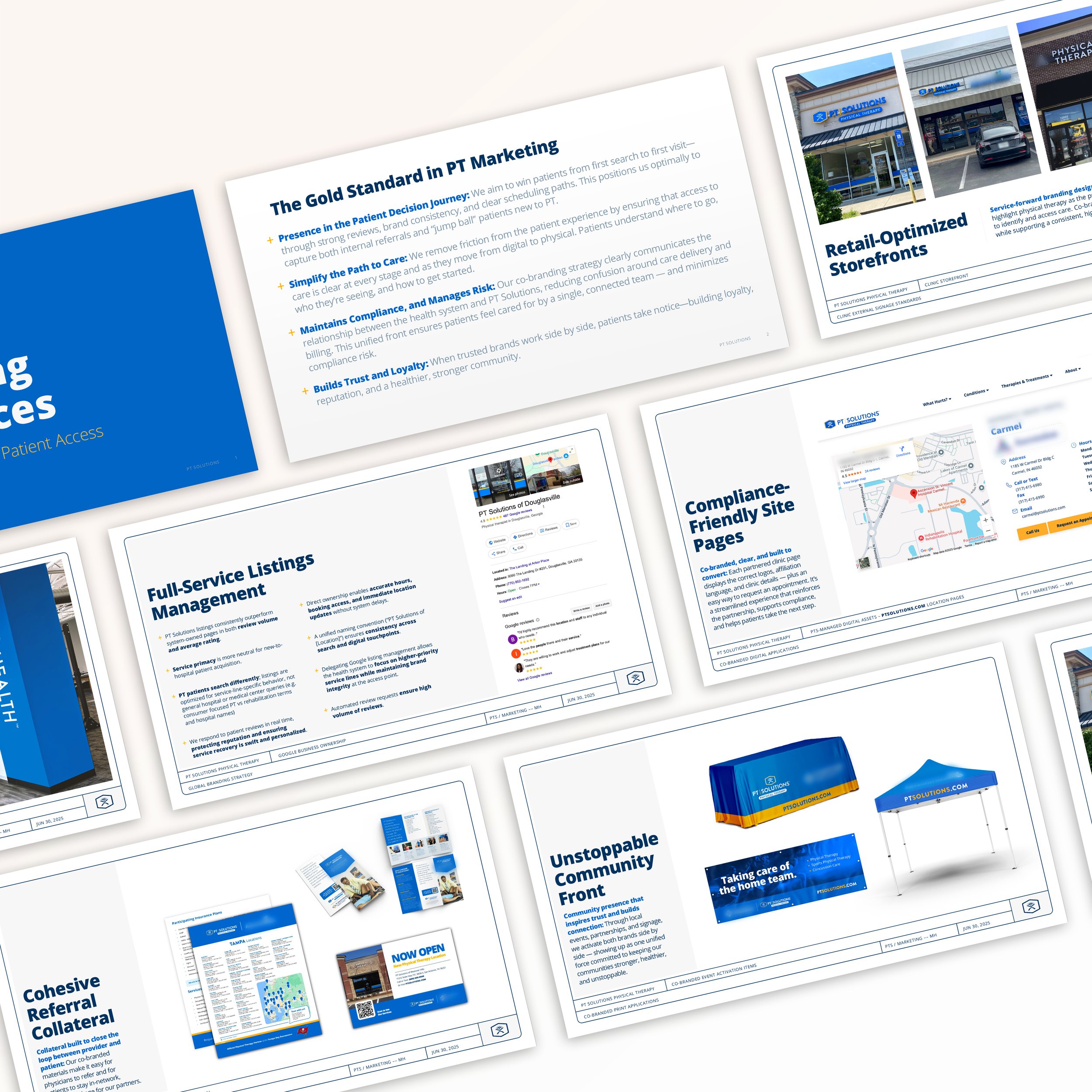
Cobranding Standards & Partner Guidelines
A scalable cobranding system designed to align hospital partners while protecting brand integrity at scale.
Challenge
As PT Solutions rapidly expanded hospital partnerships, inconsistent cobranding created real risk - diluting the brand, confusing patients, and slowing approvals across teams. While strategic guidance existed, it lived in fragments and lacked a clear structure partners could easily understand or apply.
The challenge wasn’t defining standards, it was communicating them early, clearly, and convincingly, so alignment happened before friction entered the process.
Role
I partnered with brand leadership to translate an existing co-branding strategy into a structured, visual system designed for early-stage partner conversations. My role focused on defining hierarchy, clarifying decision logic, and creating tools that could be used consistently by internal teams and external partners alike.
Approach
I designed a practical brand governance system that transformed abstract rules into usable frameworks. Rather than a rigid rulebook, the system functions as an alignment tool - helping partners understand not just what the standards are, but why they matter.
The system was built to scale across physical environments, digital touchpoints, and community activation, enabling faster approvals, clearer collaboration, and long-term consistency without sacrificing flexibility.
Company
PT Solutions Physical Therapy
Year
2025
Frames brand standards as patient-first strategy
Designed to scale across partnership types
Turns brand debates into shared logic
Applies across physical and digital touchpoints
Transforming creative operations from reactive production to strategic enablement.
Challenge
The creative team was overwhelmed by one-off requests, unclear scopes, and fragmented workflows. Work entered through multiple channels with no consistent prioritization, making it difficult to focus on high-impact initiatives or operate strategically.
Role
I led the redesign of how creative work moved through the organization - defining the intake, prioritization, and delivery model to support clarity, focus, and scale.
Approach
I designed a structured intake system that replaced ad-hoc requests with guided, self-service pathways. By combining consultation-based workflows, standardized request types, and lightweight automation, the system reduced noise, clarified scope, and elevated the creative team from order-takers to strategic partners.
Creative Intake Transformation
Company
PT Solutions Physical Therapy
Year
2024
Before:
Fragmented Creative Intake
Requests entered the system through multiple channels with no shared logic, making prioritization, planning, consistency, and reporting nearly impossible.
After:
Structured, Self-Serve Creative Intake
A centralized intake system routes work based on type, urgency, and complexity - allowing the team to prioritize strategically while enabling self-serve for high-volume needs.
Execution
Guided Entry Point
The intake system begins with a centralized portal designed to guide teams to the right solution before they ever submit a request.
Standard Creative Requests Intake Form
This form is designed for standardized creative outputs, not open-ended ideation. By constraining request types and using conditional logic, it captures the right information upfront and routes work efficiently.
Brand DAM Access
Designing a centralized asset ecosystem that enabled speed, trust, and brand consistency at scale.
Challenge
As the organization scaled, teams lacked a reliable source of truth for approved brand assets. This slowed execution, increased ad hoc requests, and introduced brand risk across regions and partners.
Role
I led the strategy, structure, and rollout of a digital asset management system, defining how assets were organized, accessed, governed, and integrated into daily workflows.
Approach
I designed the taxonomy, access logic, and governance model behind the DAM - ensuring assets were easy to find, clearly labeled, and trusted.
The system was integrated with Marq, a templating platform to support scalable templating, reduce manual updates, and ensure brand consistency across teams without ongoing creative intervention.
Company
PT Solutions Physical Therapy
Year
2025
Designed for trust at scale
Assets are organized by use case, approval status, and channel, reducing guesswork and eliminating “Is this the right file?” friction.
Clear access, clear ownership
Role-based access and governance rules ensured teams could move quickly without risking misuse or off-brand execution.
Templatized systems, not one-off tools
Brand templates were integrated with the DAM to ensure teams always started from approved, up-to-date assets, reducing manual updates and creative rework.
Lowering the barrier to adoption
To support teams who didn’t want to learn a new platform, I created lightweight asset portals with the most commonly requested materials, ensuring fast access without sacrificing governance.
Industry recognition
This work was recognized by MediaValet, with an invitation to present the system and approach at Spring DAM Week.
Self-Serve Brand Templates
A controlled templating system designed for speed at scale, without sacrificing brand integrity.
Challenge
High-frequency, low-complexity design needs were consuming the creative team’s time, slowing the organization and limiting strategic impact.
Role
I led the strategy, platform selection, and implementation of a scalable self-serve templating ecosystem.
Approach
I introduced Marq as a templating platform and designed a system of controlled flexibility - locking brand-critical elements while allowing teams to customize approved content areas.
The system reduced one-off requests, standardized execution across hundreds of locations, and shifted creative from production support to strategic enablement.
Company
PT Solutions Physical Therapy
Year
2024-2025